Showing posts with label Summary. Show all posts

Saturday, 7 April 2018

Section 4 b) Summary

The nine types of energy important to learn are:
  • Electrical energy
  • Light 
  • Sound
  • Kinetic
  • Nuclear
  • Thermal 
  • Gravitational
  • Chemical
Different actions transform energy between the different types, for example a light bulb connected to a battery would be 
Chemical Energy > Electrical Energy > Light Energy 
However, devices such as lights are not 100% efficient. If we look at the light energy emitted compared to the input we can see that a generic light bulb is only 10% efficient, most energy is wasted as heat. 

But if we look at another Sankey diagram, of a more efficient light bulb designed to save energy, only 25% is wasted as heat, it is 75% efficient:


Conduction
Conduction is heat transfer between particles. It occurs mostly in solids, because the particles are more tightly packed than in liquids or gases. Heat flows from an area of warmth to an area of cool, until it is evenly distributed throughout. Metals are good conductors because of their closely packed ions and free moving electrons. Air is a good insulator because the particles are far away, so it is used to insulate frequently. 


Convection 
Convection is a form of heat transfer that only works in a fluid, because it requires free particles to move and create a convection current. 
Convection is when particles are heated, causing them to have more kinetic energy and thus move more and become less dense, causing the hot air to rise. As more hot air rises, it displaces the air that rose before it, forcing the air to move away, and as it does so,  cool, condense, and sink. This is displaced by more sinking air, and forced back to the source of heat, where it will warm and rise again to repeat the cycle. 


An example of convection is a radiator heating a room, as shown in the diagram above. This is also why in a kettle the heating element is at the bottom, it allows convection to occur and heat the water thoroughly. 

Radiation
All objects emit heat through infrared radiation. It doesn't require particles to be transferred, it is transmitted through electromagnetic waves. Radiation and absorption of heat is increased with  bigger temperature difference, or if the object is more matte and black. 


Insulation

In houses, it is important to create insulating layers to limit heat loss through conduction, convection and radiation. 

In people, we have natural mechanisms to insulate heat (goosebumps make hairs stand on end to trap air, but this doesn't do much anymore compared to when humans were hairier), but we use layers of clothing to trap air between which insulates and limits heat loss. 

Friday, 30 March 2018

Section 3 d) Summary

Waves can be reflected, refracted and diffracted, whether they're transverse or longitudinal.

Sound waves can be measured using a device called an oscilloscope and a microphone. The microphone is connected into the oscilloscope, a sound made, and from the tracing made the frequency, amplitude, time period and wavelength can be calculated.
Louder sounds have a higher amplitude, and more high-pitched sounds have a higher frequency.

Reflection
The law of reflection says that the angle of incidence = the angle of reflection

i = r

This principle can be applied to a phenomenon known as Pepper's ghost, where lights and reflections are used to project a virtual image.


One light shines onto the background, lighting it up so the viewer can see it through the glass. The other light shines onto an image, hidden from view. The light is reflected off of this image, and travels to the glass, where it is reflected and the viewer sees it. The reflection merges with the background, so appears to be there and not just a reflection. This is called a virtual image.
This concept can also be demonstrated in a more simple manner:


The glass is equidistance from the candles, so when the light from the front candle is reflected it appears to be on the unlighted candle.

Sound experiment:

  1. Measure 100 metres from a wall, and stand there and clap with clapping blocks. Every time you hear the echo of the previous clap, clap again.
  2. Once you have a steady rhythm, time how long it takes for the time periods of 10 claps (count 11 claps) 
  3. Divide this time by 10 to find the time for 1 clap, then divide double the distance (200 m) by this number (you must double it because the wave travels the distance to the wall and back).
This will give you the speed of sound in air, but is also affected by human reaction times so will not give a totally accurate result.

Total internal reflection (finding the critical angle):
  1. Shine a ray into a semi circular prism (this is ideal, because you can shine at the mid-point of the flat side without being refracted the first time due to the shape having normals at all angles)
  2. Shine it at the mid-point from a range of different angles, starting with a smaller angle of incidence, and gradually moving it around, until the ray is in line with the flat edge. This is the critical angle: the last point at which the light is reflected. 
  3. Once the angle is greater than the critical angle, it will become totally internally reflected. 

Critical angle can be calculated with this formula: sin c = 1 / n 

Total internal reflection is useful in optic cables among other things. It allows the information to be transferred long distances without being lost, all of the light is reflected. This concept is also used in jewellery and cutting jewels such as diamonds. By creating total internal reflection, they reflect light more and are more 'sparkly'. 


Refraction

Refraction is when the direction of a wave changes as it changes from one medium to another.
You can see this when you put a straw in water, it appears bent or broken.


We can see how different objects and media refract objects through investigations.

Finding the refractive index of glass
1. Using a rectangular glass block, and trace its outline onto a piece of paper. Create a series of lines to create different angles about a normal.
2. Shine a line/ray of light from a ray box along each line, and mark the emergent line with two x's, and connect the line to the normal, and then to the angle of incidence.
3. Measure each of the angles of refraction in comparison to the angle of incidence, and use
n = sin i / sin r
for each, and find the average of n to try to erase inaccuracies.

This same experiment can be done with different shaped blocks to see how this affects it, or different media (e.g. plastic)


Diffraction

Diffraction is the spread of waves beyond a barrier. This can be seen with waves at the beach, after passing through a gap


This effect happens in the same manner with sound and light waves. For example, when a door is opened into a dark room, we see the light spread.
 

Diffraction is increased when the ratio of gap size to wavelength is balanced so the gap size is smaller and the wavelength is larger.

Diffraction doesn't just happen through gaps, though, it also happens when passing an edge.


Signals: Analogue vs. Digital

Signals can be digital or analogue, the difference being that analogue has continuous variables and digital having two fixed settings, on and off or 0 and 1.

Advantages and disadvantages:

  • Digital signals have a wider bandwidth and can carry more information
  • Digital can be more easily restored if distorted
  • Analogue signals are near impossible to restore if badly distorted. 
  • Analogue signals have an infinite range of data
  • Analogue signals are easy to process
  • Analogue signals are easily distorted
  • Digital signals travel faster
  • Digital signals are more complicated to process. 


Thursday, 29 March 2018

Section 3 c) Summary

The electromagnetic spectrum is a spectrum of electromagnetic waves/radiation, split into 7 main parts, each with its own uses and hazards.


The first section is radio waves. These waves have the longest wavelength, and lowest frequency. They are used for satellite transmissions: communicating and broadcasting. Very large doses can cause cancers (such as leukaemia), and other disorders. Luckily, most people aren't ever in contact with large doses, so this isn't much of a cause for concern.

Microwaves have a slightly higher frequency and lower wavelength than radio waves, and are obviously used for cooking in microwave ovens (the energy causes particles to vibrate in food), but they are also used in satellite transmissions. These waves however, can cause damage to body tissues as it heats them up. This can cause enzymes to denature and irreparable tissue damage. Microwaves are contained, though. In microwave ovens, they are contained within the appliance and only emitted when sealed and on. People who work on aircraft carriers and are exposed to high doses of microwaves wear clothing that reflects the radiation.

Infrared radiation is used for short range communications, such as in tv remote controls, and also for heating (toasters, heat lamps, etc.) as well as night vision equipment and thermal imaging. All objects emit IR to some degree. Its only danger is overheating, which can be avoided by attempting to cool yourself down. Have a cold drink maybe?

Visible light is the light and colours detectable by our unaided vision. It is used in photography, optic cables, screens, printers, DVDs, and anything we need to see! Dangers are simply that too much light can damage the retina in the eye and cause temporary or permanent vision loss. This can be remedied by simply not looking at bright things, like the sun (our body's natural reflexes tend to help us avoid this anyway)

Ultraviolet, or U.V. light, is emitted by the sun. It's used for tanning beds, fluorescent lights, detecting forged bank notes, hardening dental fillings, reading invisible ink, and sterilising water and food. It has many dangers, however. For example, sun burn, skin cancer and vision damage or loss. By wearing U.V.-blocking sunglasses, sun cream, and covering up with hats, clothing and shade, the effects of U.V. can be reduced.

X-rays are useful for seeing inside things, such as the bones in your body, or looking in suitcases in airports without having to open and check through it. In seeing bones, x-rays are sent through the patient, and areas such as bones absorb the radiation, leaving a white patch, while the soft tissue is easily travelled through by the rays. X-rays can cause cell damage and cancer, so precautions people who work with them daily, such as doctors or airport security include standing behind a lead shield, or containing it within a lead box. Patients receiving an x-ray near to vital organs may have lead sheets placed over their heads or chests.

Gamma rays are able to kill living cells, so are used to target cancer cells and kill them. This is very precise and avoids damaging other cells or tissue. This is called radiotherapy. It is also used in radioactive tracers, which can be put inside a patient's body to see what part of it isn't working correctly. They are also used to sterilise food and medical equipment. However gamma rays can be very dangerous. They cause mutations, especially in rapidly growing tissue (in unborn babies this is especially dangerous). It can cause cell damage, and a variety of cancers. Gamma rays can be trapped by a few feet of lead, water or concrete. Thick, dense shielding is necessary for protection.

Useful resource: http://www.darvill.clara.net/emag/index.htm

Monday, 26 March 2018

Section 3 b) Summary

Waves can be transverse or longitudinal. These two types of waves have similarities and differences:


You can see transverse waves by jerking a rope up and down, it will make an 'S' shape.
If you stretch out a slinky spring, you can push it forwards and backwards to create waves of compression, like longitudinal waves.
You can also see longitudinal waves in a ripple/wave tank.


You can use a variety of formula triangles to calculate the different aspects of waves, such as speed, frequency, wavelength, and more.
These can be used in different contexts and are important to learn and know.


Waves, when passing an edge or a gap, can be diffracted. This is when waves are bent as they pass the edge of an object, and then spread. The effect of diffraction varies depending on the ratio of the wavelength to the size of the gap.

If the gap is proportionally smaller, the diffraction effect will be more. The reverse is also true.


Sunday, 25 March 2018

Section 2 d) Summary

Electrostatic charge is unmoving electric charge, caused by the transfer of electrons when two insulators are rubbed together. Usually, electric charge is allowed to flow in a current, through a conductor. Conductors have free charged particles that allow the current to carry the charge, but insulators do not, so the charge is static; it does not move.

Common conductors include metals, molten or aqueous ionic compounds, and carbon.
Common insulators include plastics such as rubber or acrylic, as well as air, paper and glass.

Like charges repel, and opposites attract. These forces of attraction and repulsion get weaker as distance is increased. This principle allows us to harness charges and use them for our benefit

Applications of electrostatic charge:

Inkjet printers
1. Tiny inkdrops become electrically charged as they are forced out of a small nozzle.
2. They travel past two plates, one positive and one negative. The drop is repelled by the like charge and attracted to the opposite charge, directing its landing spot on the paper.
3. The voltage across the plates is changed to direct each drop to form the image.

Photocopiers
1. A projection of your image is shone onto a positively charged image plate.
2. The light causes charge to leak away from some places.
3. Negatively charged powder (toner) is attracted to the positively charged parts of the plate, then transferred onto positively charged paper.
4. The paper is heated to seal the toner.

Problems and Dangers of electrostatic charge:

Problems

  • Screens attract dust as they get charged
  • Clothes cling to one another, and the body
  • Brushing hair can cause it to become statically charged and stand up

Dangers

  • Can build up in clouds and cause lightening, which can be dangerous
  • Buildup when fueling machinery could cause a spark, and an explosion
  • Touching an object with a large charge can give you a burn, or even kill you


Investigations into electrostatic charge:

Rod and cloth
1. Hold a polythene rod next to running water. Nothing will happen.
2. Rub the rod with a cloth, so friction causes electrons to transfer from the cloth onto the rod, causing both to become charged equally but oppositely.
3. Hold the rod next to the running water again. The stream will be bent, as like charges repel and opposite charges attract.

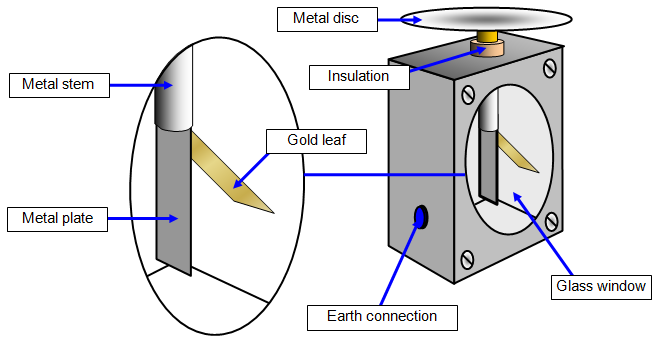
Gold leaf electroscope
1. Hold the object near the metal disc of a gold-leaf electroscope.
2. If the object is charged, this will induce a charge and cause the gold leaf to rise as it is repelled from the similarly-charged metal plate.

Suspended rods
1. Suspend a rod with a known charge, then hold your object near it.
2. If nothing happens, the object is not charged
3. If there is repulsion, the object has the same charge as the suspended rod.
4. If there is attraction, they have opposite charges.

Section 2 c) Summary

Series and parallel circuits

The current is the rate of flow of charge: I = Q/t
The voltage is the energy transferred per unit of charge: V = E/Q

In a series circuit, all of the components are connected in a line. This means the voltage is split between each of the components, but the current stays constant throughout, which is why ammeters are connected in series with components.
In a series circuit, the components are not individually controllable: they are either all on, or all off (e.g. Christmas lights). This can be disadvantageous as it means that if one of the components is broken, the whole circuit is disconnected and it can be difficult to find out which is faulty.


In a parallel circuit, the components are connected in 'branches'. Current is split between the 'branches', but each 'branch' receives the same voltage, which is why voltmeters are connected in parallel with components.
In a parallel circuit, the branches are individually controllable. A switch can be attached to each 'branch' and the components can be turned on and off as desired (e.g. different lights in a house). If one component breaks, the circuit will still work and the faulty component is easily located. 


Resistance and Resistors

Each component in a circuit has resistance; this can be thought of as like drag or friction opposing motion.
A component has greater resistance if it:

  • Emits heat (e.g. toaster)
  • Has a larger cross sectional area (of where the current flows)(e.g. thicker wires)
  • Total length of wires
  • Is made out of a less conductive material (e.g. copper has less resistance than carbon)
If there is more resistance in a circuit, less current will flow (or it will require more voltage to reach the same current). 
Variable resistors, fixed resistors, LDRs and thermistors are all components used to increase or decrease resistance in a circuit. 

Variable resistors allow the user to choose how much resistance they want, this is useful in dimmer switches for example. 

Fixed resistors are used to reduce the flow of electrons in a circuit, some appliances need a lower current to be able to work correctly. 


LDRs, or light dependent resistors, decrease in resistance when exposed to more intense light, and increase in dimmer light. These are used in burglar alarms and light intensity meters.

Thermistors are temperature dependent resistors, they increase in resistance when exposed to cooler temperatures. They are used in many appliances to maintain temperature, e.g. microwaves.

The resistance of a component can be determined by measuring the voltage and current across it in a circuit, and using this formula:
Voltage = Current x Resistance

The results can be graphed on an I-V graph (current on the y-axis, voltage on the x-axis), where the gradient is 1/R. These are the most important I-V graphs to know:

^ This is the I-V graph of a wire, or a resistor at a constant temperature. A steeper gradient means a lower resistance, and a shallower gradient means it has a higher resistance. This is according to Ohm's law: Electrical current is proportional to voltage and inversely proportional to resistance.

^ This is the I-V graph of a filament lamp. It is curved, because as the temperature of the metal filament increases so does the resistance.

^ This is the I-V graph of a diode. Diodes only allow current to flow in one direction; the resistance is very high in the opposite direction. The point at which the current increases dramatically is around 0.6 V.

To create a graph like this yourself, you must set up a circuit as shown:
Then, using the variable resistor to adjust the voltage, record the current across the component. Plot these points in an I-V graph, and draw a line of best fit.


Electrical symbols

Below is a guide on the basic components in an electrical circuit. There shouldn't be any other components that come up in the exam and most of these won't either.
The 10 most important are:

  • Cell
  • Battery
  • Filament lamp
  • Variable resistor, LDR, Thermistor
  • Power supply
  • Ammeter
  • Voltmeter
  • Diode
  • Switches
  • Fuse


Friday, 23 March 2018

Section 2 b) Summary

Mains electricity is the electricity supplied to each home. In the UK it is a.c. and 230V. A.c. means alternating current: it is constantly changing. By contrast, d.c. means direct current and does not change direction. This can be found in cell or battery powered circuits.

Current flowing though a circuit causes resistance. This can be calculated with the following formula:

Voltage = Current x Resistance
V= I R
(Remember this by calling it VIR pronounced veer)

Resistance causes a heating effect due to energy transfer. This increase in temperature also increases the resistance. This is used to our advantage in a variety of domestic situations
  • Fuses melt when the current is too high because it causes resistance and heating
  • Toasters toast bread with coils of high resistance wires that heat up
  • Kettles can heat water with a high resistance coil in the bottom of the appliance. 
Fuses and circuit breakers are chosen based on the current that should flow through the appliance with normal use. Fuses generally come in 3A, 5A, 7A and 13A. An appliance that would usually have a current of 2.3A flowing would use a 3A fuse, for example. 

Appliances are usually rated on power and voltage, so to calculate the necessary fuse we need to find out the current through this formula:

Power = Voltage x Current
P = I V
(Remember it by calling it PIV like pivot)

So an appliance with a rating of 1000W and 240V would be
1000 / 240 = 4.17 A
So we should use a 5 A fuse. 

Another important formula to know is this:

Energy transferred = Voltage x Current x Time
E = V I T
(Remember it by calling it EVIT like eviter, to avoid, in French)


Electrical circuits come with hazards that can cause injury or damage:


But there are often safety features put in place to ensure we are not hurt:


Saturday, 24 February 2018

Section 1 d) Summary

Our Planet, the Earth, is located as the third planet from the Sun in the Solar System, one of billions of stars in the Milky way galaxy, which is one of billions of galaxies in the Universe.


Gravity, a force exerted by all bodies of mass, keeps celestial bodies in orbit around each other. It pulls bodies of mass back towards others and preventing them from moving far away, creating an orbit.
An orbit is a balance between the forwards motion of the object and the force pulling it inwards. Planets have almost circular orbits, whereas comets have elongated elliptical orbits. Moons and artificial satellites orbit planets in circular patterns.
Geostationary satellites have an orbit of 1 day, keeping it stationary over one area of land, and are useful for communications.

Stronger forces of attraction occur closer to the centre of a body of mass; because of this, planets closer to the Sun move faster, and comets move more quickly when they're closer to the Sun.

Orbital speed can be worked out through the following equation:

v= (2 x π x r ) / T

Wednesday, 21 February 2018

Section 1 c) Summary

Forces
Balanced forces are forces that are equal is size and opposite in direction, and cause no change.
A force is a vector quantity; it has both size and direction.
Force is measured in newtons (N)

When forces are added together, they form a resultant force. Balanced forces always have a resultant force of 0N. If the resultant force is not 0N, the force is unbalanced, and the shape, speed, size or direction of the object will change.
There are different types of forces- they can be contact or non-contact.
Contact forces require particles to touch, for example friction, but non-contact forces act over a distance and don't require the particles to make contact to act, for example magnetic force.

Contact:
  • Friction
  • Drag
  • Upthrust
  • Tension
  • Normal
  • Air resistance

Non-Contact:
  • Magnetic
  • Electrostatic 
  • Gravitational/weight
  • Nuclear
Newton's laws of motion state that:
1. An object with balanced forces will not change in velocity.
2. A resultant force means acceleration
3. Every force has an equal opposing force.

The third law means that as you stand on the Earth, you are exerting a force on the ground, but the Earth exerts an equal force on you. This is called normal force.

As a boat travels through the water, a number of forces act on it. The upthrust from the water opposes the pull of gravity, and they are balanced. The force exerted by the boat as it moves through the water is opposed by water resistance, and above the water level motion is opposed by air resistance. These are both forms of drag; they are forces that oppose motion.

Friction is another form of drag, it happens when an object moves along a solid and is a force in direct opposition to motion.

Vectors and Scalars
Vectors and scalars are measures of quantity. A scalar is a measure of magnitude, while a vector is a measure of both direction and magnitude.


Terminal Velocity
Terminal velocity happens when the vertical force on an object are balanced. For example, a ball is dropped from a height. Initially, the ball will be accelerating because the weight is greater than the air resistance, but soon the weight and air resistance will become equal as the resistance builds up as velocity increases. Equal forces mean that the ball is no longer accelerating and is now travelling at a constant speed: it has reached terminal velocity. We can test terminal velocity using experiments with parachutes or sycamore seeds:

Sycamore seeds:
Seeds should be collected and the length of wing measured. They should be dropped and timed, and a graph drawn to show the relationship between length of wing and speed.

Parachutes:
Dropping same-weighted objects attached to parachutes of different sizes from the same height, and measuring the time it takes for the object to reach the ground. This is investigating the air resistance on the parachute, and should show that with increased surface area, the object will move more slowly.

Principle of Moments
If an object is balanced its clockwise and anticlockwise moments are equal.
If the moments are not equal, there is a resultant moment and the object will turn.

Examples of Balanced moments:


In the example above, we can clearly see the clockwise and anticlockwise moments are equal. On both sides, we multiply:
Force x Distance from pivot = Moment
50N x 2m = 100Nm


In this example, the blocks are in different positions and exert different forces, which must both have the same moments:
Force 1 x Distance 1 = Force 2 x Distance 2 
Moment 1 = Moment 2
50N x 2m = 100Nm
100N x 1m = 100Nm

The clockwise and anticlockwise moments are equal.


In the above example, a light beam is supported by two blocks at either end. The block placed in the centre exerts a force of 900N, which is spread equally between the two supports as they are at equidistance - the ratio is 1:1

450N + 450N = 900N

The sum of the force exerted by the supports must always equal the force exerted by the block. 


In this example, the block is closer to the left support. There is more force exerted on the closer support, and the distance can be split in a ratio of 1:2. We known there is more force on the closer support, so we know the force is distributed 2:1. We can divide 900N by 3, giving 300N to find the value of 1 in the ratio. 

900N / 3 = 300N

From this, we can put the values in the ratio to find the forces exerted on the supports

2 x 300N = 600N

1 x 300N = 300N

600N : 300N


Centre of Gravity
An object's centre of gravity is the point through which its weight acts. This point can be placed on a pinpoint and it will not overbalance because the weight acting on every side of it is equal. 
The centre of gravity can be found in a 2D object, for example a piece of paper in any shape, by suspending it and marking the vertical line below the point of suspension. If this is repeated, one point can be found where all the lines cross. This is the centre of gravity. 

Vehicular Safety
Forces and moment play a big part in ensuring driver and passenger safety in moving vehicles. Many safety features designed to prevent injury in the event of a crash use principles of momentum in their design. 
Force Felt = Momentum / Time
So while the momentum can't be altered, the time can be. Safety features increase the time over which momentum decreases, therefore decreasing the impact force. These include:
  • Air Bags
  • Seat Belts
  • Crumple zones
Moving vehicles all have a stopping distance (made of thinking distance and braking distance) that is important to maintain to avoid dangerous collisions. The faster or heavier a vehicle is, the more momentum it has, making it more difficult to slow down in a short period of time and a short distance. If stopping distances are not maintained, it can lead to collisions and pile-up.

Stopping distances in cars can be affected by:
  • Sobriety
  • Old age
  • Tiredness
  • Inexperience
  • Speed
  • Mass of vehicle
  • Brake quality 
  • Weather conditions
  • Road surface
  • Tyre condition
Hooke's Law and Elasticity
Hooke's law states that the extension of an elastic object is proportional to the force acting on it. 
An elastic object is an object that can be stretched by a force, but will return to its original physical state once the force is no longer acting on it. However, all objects have an 'elastic limit', the point at which so much force has been applied that it loses elasticity and is unable to return to its original shape. After the elastic limit has been reached, the principles of Hooke's law are no longer relevant. 

Formulas

Weight = Mass x Gravity

Force = Mass x Acceleration

Momentum = Mass x Velocity

Force = Change in Momentum / Time taken

Moment = Force x Perpendicular distance from pivot

Tuesday, 13 February 2018

Section 1 b) Summary

Distance-time graphs are used to show the change in distance over time: the displacement from the starting point. The velocity of an object can be determined from the gradient of one of these graphs. Negative points mean that the object is travelling in the opposite direction, and a negative gradient means the object is travelling back to the starting point.

Velocity-time graphs are used to show the change in velocity over time. The area between the line and the x-axis is used to calculate the distance travelled and the gradient is the acceleration. A negative gradient indicates deceleration and negative points mean the object is travelling backwards.

Experiments to investigate:

You could use ticker tape and a toy car on a ramp to plot a distance time graph of its movement. A mark is made on the tape at a regular interval, set by the user (e.g. every second). The distance between marks can be measured and the movement of the car plotted on a distance-time graph.

Another way of investigating the movement of an object, for example a tennis ball, is by dropping it or pushing it down a ramp and measuring the time it takes for the ball to reach a certain point after it begins moving. From this, the average speed can be calculated using the speed triangle.

Equations:

Velocity = Change in Distance / Change in Time

Acceleration = Change in Velocity / Change in Time

Section 4 b) Summary

The nine types of energy important to learn are: Electrical energy Light  Sound Kinetic Nuclear Thermal  Gravitational Chemical ...