Showing posts with label d) Electric charge. Show all posts

Sunday, 25 March 2018

Section 2 d) Summary

Electrostatic charge is unmoving electric charge, caused by the transfer of electrons when two insulators are rubbed together. Usually, electric charge is allowed to flow in a current, through a conductor. Conductors have free charged particles that allow the current to carry the charge, but insulators do not, so the charge is static; it does not move.

Common conductors include metals, molten or aqueous ionic compounds, and carbon.
Common insulators include plastics such as rubber or acrylic, as well as air, paper and glass.

Like charges repel, and opposites attract. These forces of attraction and repulsion get weaker as distance is increased. This principle allows us to harness charges and use them for our benefit

Applications of electrostatic charge:

Inkjet printers
1. Tiny inkdrops become electrically charged as they are forced out of a small nozzle.
2. They travel past two plates, one positive and one negative. The drop is repelled by the like charge and attracted to the opposite charge, directing its landing spot on the paper.
3. The voltage across the plates is changed to direct each drop to form the image.

Photocopiers
1. A projection of your image is shone onto a positively charged image plate.
2. The light causes charge to leak away from some places.
3. Negatively charged powder (toner) is attracted to the positively charged parts of the plate, then transferred onto positively charged paper.
4. The paper is heated to seal the toner.

Problems and Dangers of electrostatic charge:

Problems

  • Screens attract dust as they get charged
  • Clothes cling to one another, and the body
  • Brushing hair can cause it to become statically charged and stand up

Dangers

  • Can build up in clouds and cause lightening, which can be dangerous
  • Buildup when fueling machinery could cause a spark, and an explosion
  • Touching an object with a large charge can give you a burn, or even kill you


Investigations into electrostatic charge:

Rod and cloth
1. Hold a polythene rod next to running water. Nothing will happen.
2. Rub the rod with a cloth, so friction causes electrons to transfer from the cloth onto the rod, causing both to become charged equally but oppositely.
3. Hold the rod next to the running water again. The stream will be bent, as like charges repel and opposite charges attract.

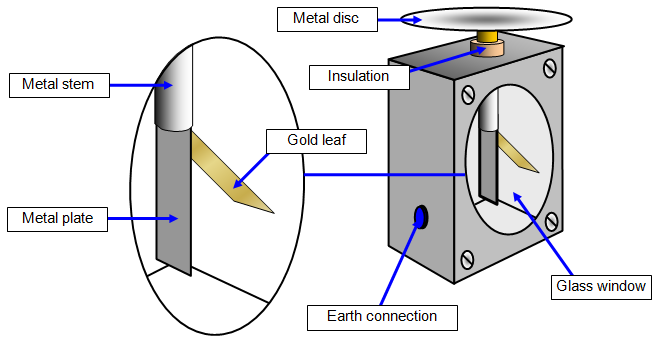
Gold leaf electroscope
1. Hold the object near the metal disc of a gold-leaf electroscope.
2. If the object is charged, this will induce a charge and cause the gold leaf to rise as it is repelled from the similarly-charged metal plate.
Suspended rods
1. Suspend a rod with a known charge, then hold your object near it.
2. If nothing happens, the object is not charged
3. If there is repulsion, the object has the same charge as the suspended rod.
4. If there is attraction, they have opposite charges.

Section 2 d) Key Words

Conductor: A material that allows current to flow through it due to free charged particles.

Earthed: When an object allows its charge to flow to earth and becomes neutral.

Earthing strap: A flexible metal strap that provides a path of least resistance for charge to travel down to earth.

Electrostatic charge: An electric charge that is not in motion; it is not flowing. Basically electricity without the current.

Insulator: A material that does not allow current to flow through it as it has no free charged particles.

Static Electricity: Unmoving electricity, electrostatic charge.

Section 2 d) Specification

2.19 identify common materials which are electrical conductors or insulators, including metals and plastics

Conductors:

  • Copper 
  • Lead
  • Molten or aqueous ionic compounds
  • Silver
  • Gold
  • Carbon

Insulators:

  • Rubber
  • Air 
  • Acrylic
  • Glass
  • Polyester
  • Paper


2.20 describe experiments to investigate how insulating materials can be charged by friction

Polythene and acetate rods experiment

  1. Rip up some pieces of paper and wave each of the rods near them. Nothing will happen.
  2. Rub the polythene rod with a duster. The electrons will transfer from the duster to the rod through friction, giving the rod a negative charge and the duster an equal positive charge. 
  3. Rub the acetate rod with a duster. The electrons will transfer from the acetate rod to the duster, giving it a negative charge and the rod an equal positive charge.
  4. Hold the rods near the paper individually. The pieces will be attracted to the rod. 
This can also be done by rubbing a balloon on a woolly jumper. The balloon can then attract small light objects, like ripped up paper or hair. 


2.21 explain that positive and negative electrostatic charges are produced on materials by the loss and gain of electrons

When rubbed together, friction is created between two objects. This force causes electrons to be transferred from on object to another, giving the objects equal but opposite charges.
These charges are electrostatic, meaning they do not flow.

2.22 understand that there are forces of attraction between unlike charges and forces of repulsion between like charges

Like charges repel, while opposite charges attract. These forces of attraction and repulsion weaken with distance.

2.23 explain electrostatic phenomena in terms of the movement of electrons

Electrostatic phenomena is the transfer of electrons from one object to another through friction. Positive particles never move; positive electrostatic charge is simply due to absence of negative particles.

2.24 explain the potential dangers of electrostatic charges, eg when fuelling aircraft and tankers

Electrostatic charges can cause sparks (this is what lightening is - buildup of electrostatic charge caused by friction between particles within the clouds that cause the bottom of the cloud to have a negative charge and the top to be negatively charged). These sparks can be very dangerous, for example when fueling a car or aircraft, a spark could cause an explosion. Because of this, electrostatic buildup in the tank is earthed by the metal fuel nozzle and earthing straps.

2.25 explain some uses of electrostatic charges, eg in photocopiers and inkjet printers.

Electrostatic charges can also be used to our advantage, for example in photocopiers and inkjet printers.

How an inkjet printer works:
  1. Tiny ink drops are forced out of a fine nozzle, the friction making them electrically charged.
  2. The charged drops are deflected as they pass through two oppositely charged metal plates.
  3. The drops are attracted to the plate with an opposite charge, and repelled from the similarly charged plate.
  4. The size and direction of the voltage across each plate is changed as each drop falls, causing them to land on different parts of the paper
How a photocopier works:
  1. An image of what you want to copy is projected onto a positively-charged image plate.
  2. Lighter parts of the image cause the charge to leak away in some parts of the paper.
  3. The positively charged parts of the image plate attract negatively charged black powder, which is then transferred onto positively charged paper.
  4. The paper is heated, causing the powder to stick.

Section 4 b) Summary

The nine types of energy important to learn are: Electrical energy Light  Sound Kinetic Nuclear Thermal  Gravitational Chemical ...